Beekind®
(01) Smart Beekeeping Assistant © 2024
(01) (Read more) © 2024

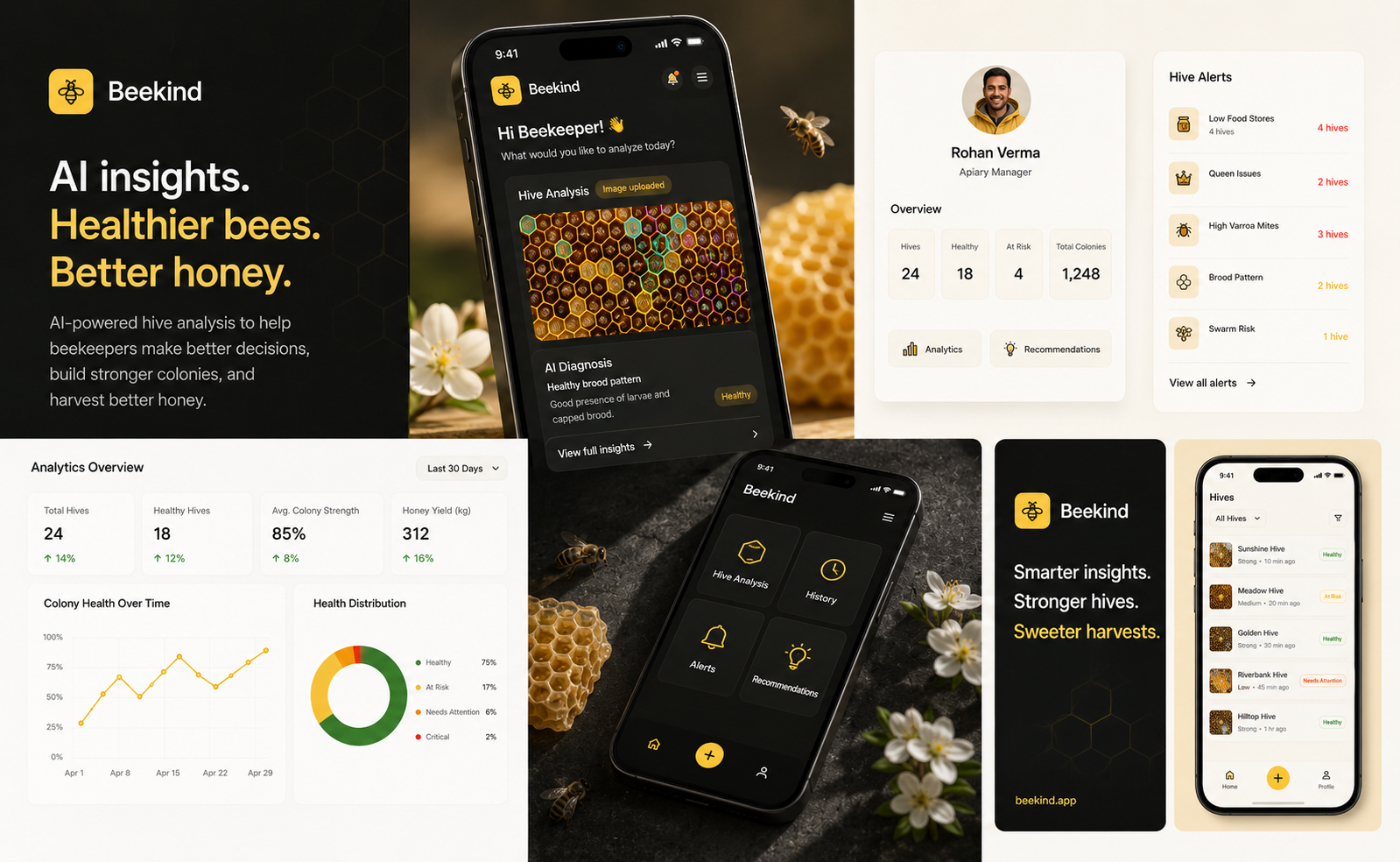
      Beekind brings computer vision and LLMs to traditional beekeeping, reading hive health from a single photo and answering questions in the beekeeper's own language®

(Problem)

Traditional beekeeping runs on handwritten manuals and word of mouth. Rural beekeepers inspect hives by hand, a slow process that often misses the early signs of disease, pests, or a failing colony until the loss is already done.

There is also little community or expert support to fall back on, so heavy losses go unexplained and the real productivity of a hive is rarely understood or improved.

(Year)
2024
Beekind
(Solution)

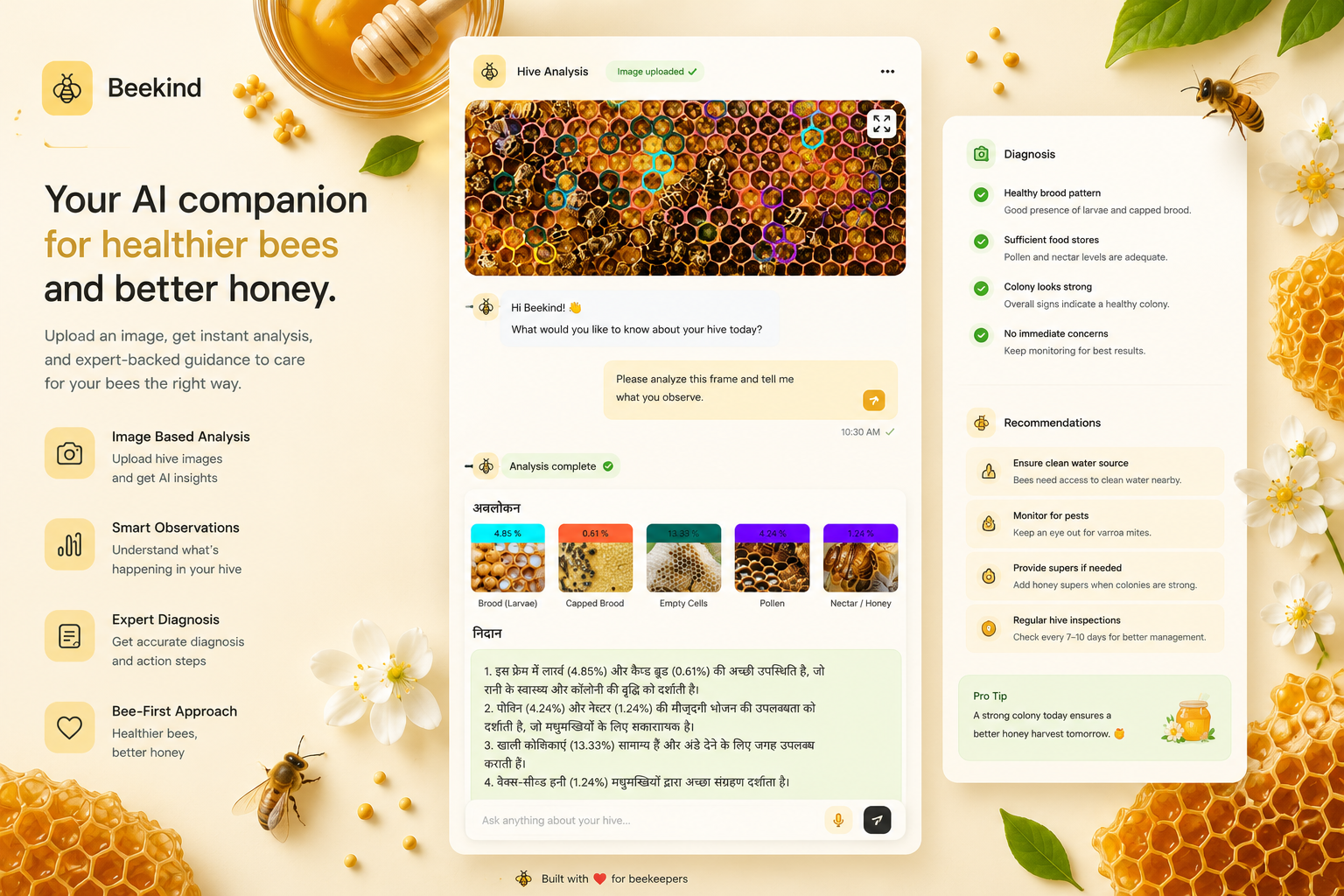
Beekind reads hive health straight from a photo. A computer-vision pipeline detects and classifies honeycomb cells, masks out the bees, and turns a glance at the comb into structured, comparable data.

On top sits a multilingual RAG assistant, so a rural beekeeper can simply speak in their own language and get grounded, expert-level guidance in return.

(Impact)
  • Supported the broader BeeKind ecosystem, which has helped deploy 6,000+ beehives across 8 ecological zones in India.
  • Contributed to tools designed to assist 1,800+ women beekeepers with accessible hive monitoring insights.
  • Enabled rural beekeepers to access guidance through multilingual AI assistance in their own language.
  • Explored how AI can strengthen sustainable beekeeping, supporting pollination and biodiversity.
Honeycomb cell analysis
(02) (Technical design) Six steps
01

Data Collection

Good hive imagery is scarce. Public datasets for honeycomb analysis are limited and often incomplete, so the first job was building a corpus worth training on.

Data was gathered and curated from several sources, including open datasets like DeepBee, publicly available images from Google and YouTube, and ground-level photographs taken at the hives themselves.

02

Data Labelling

A beehive is a deceptively complex structure, every cell unique, and the model has to tell those cell types and features apart.

I built a pipeline using a Circle Hough Transform to detect honeycomb cells automatically, then hand-labelled each detected cell into one of seven categories to teach the model what it was looking at.

03

Model Selection

Several detectors were evaluated for finding small objects inside a busy hive image, including YOLOv5, YOLOv7, YOLOv8, and CellNet.

An enhanced CellNet handled honeycomb cell classification, while separate models detected bees and masked them out of the frame so they couldn't interfere with the cell readings.

04

CV Pipeline

With the models chosen, the pieces were stitched into a single computer vision pipeline that takes a raw hive photo and returns a structured read of its health.

Detection, bee masking, and cell classification run in sequence, turning a glance at the comb into measurable, comparable data a beekeeper can act on.

05

AI Assistant

To make the system usable in the field, a conversational assistant was layered on top using a Retrieval-Augmented Generation approach.

It answers questions on hive health, pest detection, colony management, and seasonal practices, grounding every response in domain-specific knowledge so the advice stays relevant and accurate.

06

Multilingual Interaction

Many rural beekeepers prefer to talk in their local language, so the assistant was built to meet them there.

My work focused on the language layer, integrating Bhashini translation APIs, speech recognition, and text-to-speech so a beekeeper can simply speak and be understood.

(03) (Key learnings) Building Beekind
01

Building a usable dataset was harder than the modelling. In a niche domain like hive imagery, curating and labelling data is most of the work.

02

Masking out distractors, the bees, before classification made cell readings far more reliable than a single end-to-end model ever could.

03

Technology only helps if it meets people where they are. The multilingual voice layer mattered as much as the vision accuracy.

(04) (More works) © 2024
Chetto
Chetto® © 2025
Whatsapp Workflows
Pantry
Pantry® © 2026
AI Kitchen Assistant
KnowChem ELN
KnowChem ELN® © 2026
Electronic Lab Notebook

LET'S WORK
TOGETHER.

anannya0316@gmail.com +91 7796699769
ANANNYA